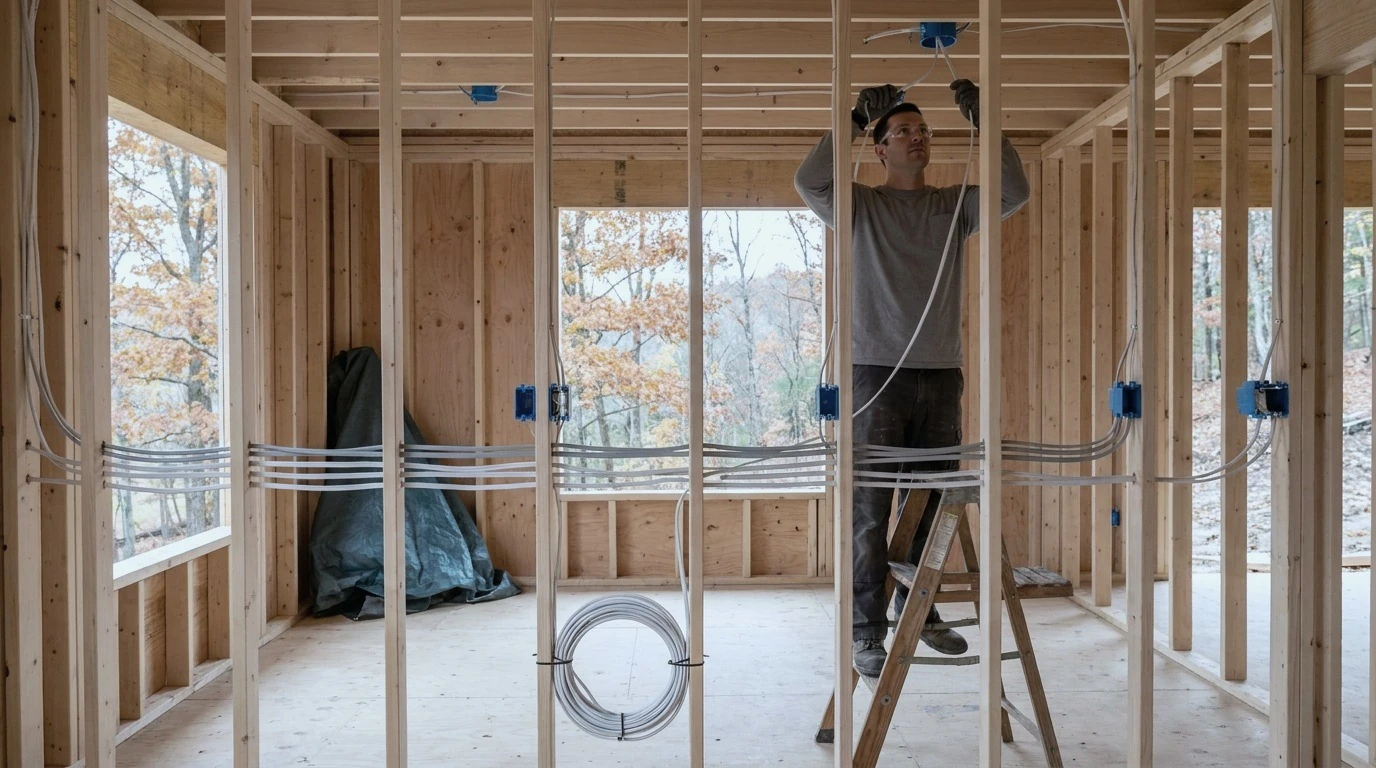
A general contractor manages your entire project and coordinates every trade, while a construction company, working as a subcontractor, specializes in one trade like electrical or roofing. For most Middleton renovations and custom builds, hiring a general contractor or a design-build firm gives you single-point accountability instead of managing specialists yourself.
When you are planning a home renovation or building a custom home in Middleton, MA, understanding the difference between a contractor and a construction company can save you time, money, and stress. Many homeowners wonder who they should hire for a comprehensive project, what risks come with managing multiple specialists themselves, and how each choice affects their timeline and liability.
This article breaks down the distinct roles, responsibilities, and licensing requirements of contractors versus construction companies, so you can make the right decision for your project from start to finish. The distinction matters most when your work spans several trades, where the wrong structure leaves you coordinating specialists you may not have the experience to manage.
A general contractor serves as the central manager for your construction project, overseeing every phase from start to finish. From the very beginning, a contractor collaborates with the client to create a budget that reflects the scope and goals of the project. The scope of work is comprehensive. They handle negotiating deals with clients, monitoring day-to-day operations of a construction site, and managing vendor and trade relationships. Their responsibilities include constructing new buildings, renovating buildings, making necessary repairs, assessing project plans, and overseeing physical labor.
General contractors also take on critical management duties. These include providing required materials, supplying needed labor, hiring subcontractors for specialized projects, overseeing quality and timeliness of work, monitoring schedule and cash flow, and keeping accurate records. They typically work for themselves as self-employed professionals or business owners, finding their own customers and managing their own operations. They often own and operate the necessary equipment for a project, giving them greater control over timelines and quality.
A construction company typically focuses on a specific trade area or project phase. Unlike general contractors who manage entire projects, these specialized companies bring deep expertise in one particular area. Their services are focused on the execution of their particular trade, such as concrete, electrical, or roofing. This specialization means they have extensive training and often specialized equipment for their specific work.
The duties of construction companies working as subcontractors include complying with the terms of the subcontractor agreement, frequently communicating with the general contractor and customer, adjusting to policy and procedure changes as needed, performing labor and completing construction projects by their due dates, and staying within a set budget. They do not bear responsibility for overall project management, budget oversight across multiple trades, or coordination of the various construction phases. Their focus remains on executing their specialized work to the highest standard. The core differences look like this:
| Aspect | General Contractor | Construction Company (Subcontractor) |
| Scope | Manages the entire project | Focuses on one trade or phase |
| Responsibility | Budget, schedule, and all trades | Executing their specialized work |
| Coordination | Hires and manages subcontractors | Reports to the general contractor |
| Best for | Comprehensive, multi-trade projects | Specific work like roofing or electrical |
In Massachusetts, general contractors are considered construction supervisors, and there are several types of construction supervisor licenses (CSL). Understanding these requirements helps you verify that your contractor is properly qualified. To qualify for a CSL, a person must prove they have three years of experience in building construction or design, which ensures a baseline level of competency and experience.
Massachusetts offers three main types of Construction Supervisor Licenses:
| License Type | What It Covers |
| Restricted CSL | One- and two-family dwellings |
| Unrestricted CSL | Any building up to 35,000 cubic feet |
| Specialty CSL | Specific trades like roofing, masonry, demolition, and insulation |
The CSL exam is an open-book test covering Massachusetts building codes, construction safety, and general construction principles, with a passing score of at least 70 percent required.
Any contractor or subcontractor who intends to work on a one- to four-family residential property in Massachusetts must register as a home improvement contractor. This registration provides important consumer protections. The HIC program processes consumer complaints, maintains an arbitration program, and compensates eligible homeowners up to $25,000 from the Guaranty Fund for unpaid judgments against contractors. This safety net protects homeowners from financial loss due to contractor misconduct. The consequences for working without proper licensing are serious, and it is punishable by a fine of up to $5,000 and up to two years in jail.
The choice between hiring one general contractor or managing multiple construction companies yourself depends on your project scope and your willingness to take on management responsibilities.
The client deals with one contractor who is responsible for the entire project, reducing the hassle of managing multiple contracts and ensuring accountability. This single point of responsibility simplifies communication and problem-solving. A reputable general contractor in Middleton collaborates closely with clients to understand their unique needs and provide customized solutions, bringing project management expertise that most property owners lack. General contractors also have a wide range of connections with experts in design, architecture, and engineering. These established relationships often result in better pricing and more reliable work, which is why this approach is generally recommended for comprehensive projects requiring broad coordination across multiple trades and phases.
Construction companies are typically best hired directly for specific, expert work such as roofing, electrical, or plumbing jobs. This approach is suitable for smaller works and refitting that do not require full project management. However, it requires you to perform significant project management duties. You will be responsible for scheduling coordination, quality oversight, and ensuring all work aligns and meets building codes. If you lack construction experience, these responsibilities can become overwhelming and lead to costly mistakes.
Design-build construction is a delivery method involving a single contract between the owner and the builder. This integrated approach offers distinct advantages over traditional methods. Unlike traditional construction contracts that require two separate entities, a designer and a contractor, a design-build contract combines these two roles into one. This eliminates the common problem of designers creating plans that contractors find impractical or expensive to execute. Partnering with a design-build construction company means the people designing your home are the same people building it.
The design-build model delivers measurable advantages. Faster delivery comes from removing the bidding phase and letting design and construction happen concurrently. The process is smoother because a single source of responsibility eliminates the blame game. Collaboration improves because professionals work within a single team, resulting in fewer change orders. Costs benefit because the actual builders are involved in the design phase, and accuracy improves because the project budget is established from the start. The model performs 102 percent faster in delivery speed than traditional design-bid-build, with 3.8 percent less cost growth. For custom home builders and homeowners in Middleton, this means getting into your new home faster while staying within budget.
Knowing how contractors structure their pricing helps you make informed decisions and avoid surprises during your project. The two most common structures work very differently:
| Contract Type | How It Works | Best When |
| Fixed-price | Total cost is predetermined and the contractor holds the risk | You want budget certainty |
| Cost-plus | Documented costs plus a set markup | Scope is straightforward and you trust transparency |
With fixed-price contracts, the total cost is predetermined, and the contractor's overhead and profit are included in the price. Fixed-price bids are typically higher than cost-plus because the contractor is taking on more risk. Homeowners know the price going into a project and will pay that price regardless of costs that may arise. This provides budget certainty but may result in paying more if the project goes smoothly without complications.
The contractor provides a thorough estimate of expenses upfront and then carefully documents and provides its records to the client. The plus represents any costs not part of the initial estimate along with the separate fee, which is the contractor's predetermined markup. This approach can save money on straightforward projects but requires trust in your contractor's transparency and record-keeping.
A change order is a document used to alter the original agreement on a construction project. It details changes in the scope of work, cost, and schedule that are required. The most important rule about change orders is simple: work should never start on the assumption that the property owner will approve a change later. Always get written approval before any additional work begins to avoid disputes.
Understanding your warranty protections is essential when working with contractors in Massachusetts. In Massachusetts, there is a three-year implied warranty of habitability after the sale of a new home, and no parties involved in the transaction have the power to void or overlook it. This warranty shields new homeowners from latent defects that cause significant safety or habitability issues. These are defects that were not visible during the initial inspection but emerge later. This legal protection applies regardless of what any contract says, giving you important recourse if serious problems develop within three years of purchase.
Start by asking for recommendations from neighbors, friends, and family. Local references are especially valuable in Middleton, where word-of-mouth reputation matters. Interview candidates before requesting bids and confirm the contractor regularly performs the type of work you need, since not all contractors have equal experience with every type of project.
Check licenses, reviews, and references, and verify any required licenses through the issuing agency. Do not rely solely on what contractors tell you, but independently verify their credentials. Get at least three written estimates, since detailed written estimates allow you to compare not just prices but also the scope of work each contractor proposes.
Select the contractor, not just the price, and consider communication, professionalism, and how clearly they answered questions. The lowest bid is not always the best value if it comes from someone difficult to work with or who cuts corners. Work should not begin until a signed contract is in place, so read the fine print carefully and make sure you understand all terms before signing.
Understanding what it means for a contractor to be licensed, bonded, and insured is the single best way to protect yourself from financial loss, liability exposure, and shoddy work. Verify that the contractor maintains at least $500,000 in commercial general liability coverage per occurrence and workers' compensation insurance if they have employees. Request certificates of insurance and confirm they are current before any work begins.
Hire a general contractor for comprehensive, multi-trade projects, since they coordinate everything under one point of responsibility. Hiring construction companies directly suits small, single-trade jobs like roofing or electrical, but you take on all the project management yourself.
For residential work, a contractor needs a Construction Supervisor License and must register as a Home Improvement Contractor. Always verify both credentials independently through the issuing agency rather than relying on the contractor's word.
A CSL is the Massachusetts license for construction supervisors, requiring three years of experience. It comes in Restricted for one and two-family homes, Unrestricted for buildings up to 35,000 cubic feet, and Specialty licenses for specific trades.
Home Improvement Contractor registration provides consumer protections, including a complaint process, arbitration, and a Guaranty Fund that compensates eligible homeowners up to $25,000 for unpaid judgments against a registered contractor.
Working without proper licensing in Massachusetts is a serious offense, punishable by a fine of up to $5,000 and up to two years in jail. This is one reason to verify credentials before any work begins.
A fixed-price contract sets the total cost upfront, giving you budget certainty while the contractor holds the risk. A cost-plus contract charges documented costs plus a set markup, which can save money on straightforward projects but requires trust in the contractor's transparency.
A change order documents any change to the original scope, cost, or schedule. The essential rule is that work should never begin on the assumption of later approval. Always secure written approval before additional work starts to avoid disputes.
Massachusetts law provides a three-year implied warranty of habitability on new home construction. It protects against latent defects affecting safety or habitability that appear after inspection, and no contract can void this legal protection.
Confirm the contractor carries at least $500,000 in commercial general liability coverage per occurrence, plus workers' compensation if they have employees. Request current certificates of insurance and verify they are active before any work begins.
Design-build combines design and construction in a single contract, so one team is accountable throughout. It delivers faster timelines, fewer change orders, better collaboration, and budget certainty compared with coordinating a separate designer and multiple trades yourself.
The difference between a contractor and a construction company comes down to scope and accountability. A general contractor manages your whole project and coordinates every trade, while a construction company executes one specialized piece of the work. For a straightforward single-trade job, hiring a specialist directly can make sense. For a renovation, addition, or custom home construction project that spans multiple trades, a general contractor or design-build firm spares you the burden and risk of coordinating specialists yourself.
Whichever route you choose, protect yourself the same way: verify licensing and insurance, insist on a signed contract, require written change orders, and lean on Massachusetts' consumer protections. Do that, and you set your Middleton project up to finish on time, on budget, and to the standard you expect. When you are ready to talk through your project with a licensed local team, schedule a consultation and move forward with clarity.
Choose the right builder for your project.
Build with a licensed Middleton design-build company.
© 2025 Genesis Construction and Development Inc. - All rights reserved | Web Design & SEO By: Authority Solutions®