Custom home building materials in Massachusetts must balance three demands at once: New England climate durability, interior aesthetic longevity, and construction budget realities. The right exterior envelope resists freeze-thaw cycles, coastal salt air, and heavy snow loads while the interior finishes hold up to twenty years of family life. Homeowners who make material decisions early, coordinated with their builder rather than after design lock, typically save 8 to 15 percent on total finish costs and avoid the mid-project substitutions that erode the look of a custom home.
Material selection is the point in the custom home process where most homeowners feel the deepest overwhelm. There are eight or nine viable siding options, a dozen countertop categories, five broad flooring families, and hundreds of window manufacturers. Each choice interacts with the others, with the climate, and with the total budget. Get it right and the home looks intentional for decades. Get it wrong and the exterior needs repainting on year seven, the flooring cups after the first humid summer, and the countertops stain the first time a spilled glass of red wine goes unwiped.
At Genesis Construction and Development, we walk North Shore and Greater Boston homeowners through this decision matrix during the design phase, not after. Our clients across Danvers, Peabody, Salem, Beverly, Andover, and Middleton learn early which materials for custom home construction actually earn their price premium in the Massachusetts climate and which do not. This article covers what we tell every homeowner about custom home finishes, exterior envelope selection, and the specific climate pressures that shape every material choice on a Massachusetts residential project. As a custom home builder based in Middleton, we build our recommendations around three decades of watching how materials age on Essex County and Middlesex County lots.
The North Shore climate is punishing to building materials in ways that homeowners moving from warmer regions often underestimate. A typical Middleton or Andover site will see roughly one hundred freeze-thaw cycles per year, meaning water that seeps into any porous surface expands and contracts one hundred times between November and April. Salt air from the coast reaches inland to towns like Salem, Beverly, and Marblehead and quietly corrodes fasteners, hardware, and low-grade metal flashing. Heavy snow loads sit on roofs from January through March, which means the roof system has to shed weight without ice damming at the eaves.
Any material that ignores these three pressures fails early. A cedar shingle nailed with electro-galvanized nails on a Beverly coastal home will bleed rust stains within four years. A composite deck board rated for southern climates will warp after two winters. A budget window with a standard aluminum spacer will show condensation streaks on the frame every cold morning. The right custom home building materials are the ones engineered for our specific climate, not the ones that photograph well in a national product catalog.
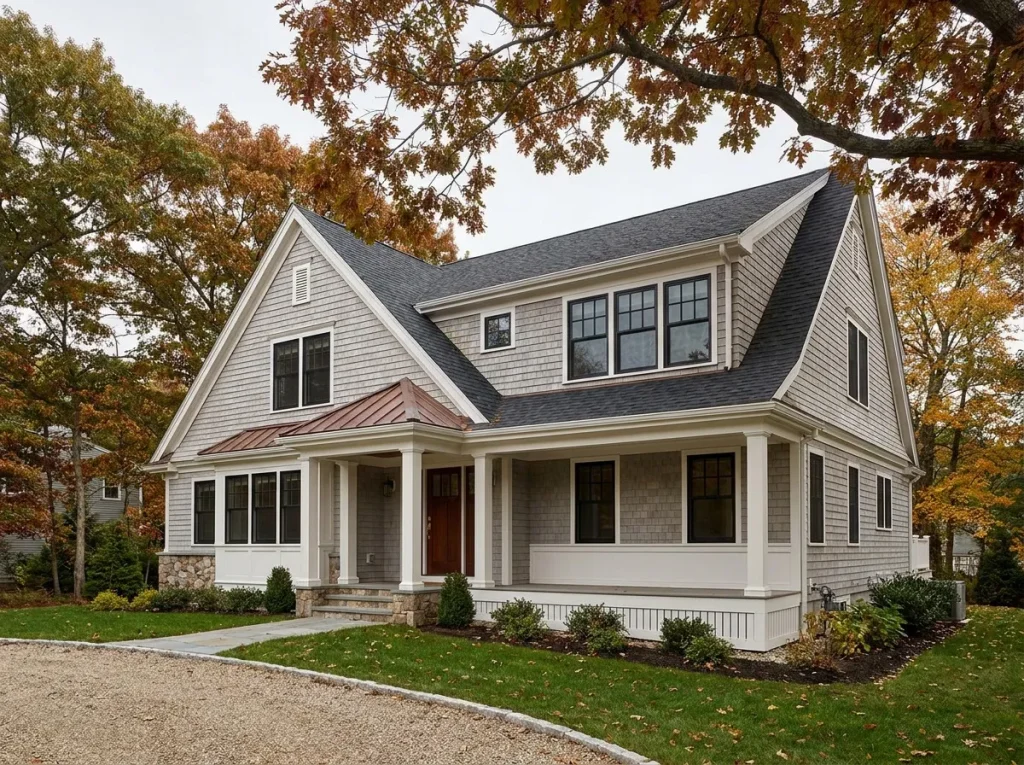
The exterior envelope is where climate durability matters most, because every square foot of it is exposed to weather every day. We think about the envelope in four systems: siding, roofing, windows and doors, and exterior trim. Each system has to work with the others, and each has price tiers that correspond to different lifespans and maintenance profiles.
Siding is the most visible material choice on any custom home, and it drives a large share of both the aesthetic and the maintenance schedule. The five siding categories that make sense in Massachusetts are cedar shingle, fiber cement, engineered wood, vinyl, and natural stone or brick veneer as an accent. Each carries different trade-offs.
| Siding Material | Typical Lifespan (MA Climate) | Maintenance Cycle | Aesthetic Fit |
|---|---|---|---|
| Cedar shingle | 30 to 50 years | Restain every 5 to 8 years | Classic New England, coastal, colonial |
| Fiber cement (Hardie) | 40 to 50 years | Repaint every 12 to 15 years | Modern, farmhouse, transitional |
| Engineered wood | 25 to 35 years | Repaint every 8 to 10 years | Transitional, budget-conscious builds |
| Vinyl | 20 to 40 years | No repaint required | Value-focused, secondary elevations |
| Brick or stone veneer | 75+ years | Minimal, occasional repointing | Accent walls, chimneys, water tables |
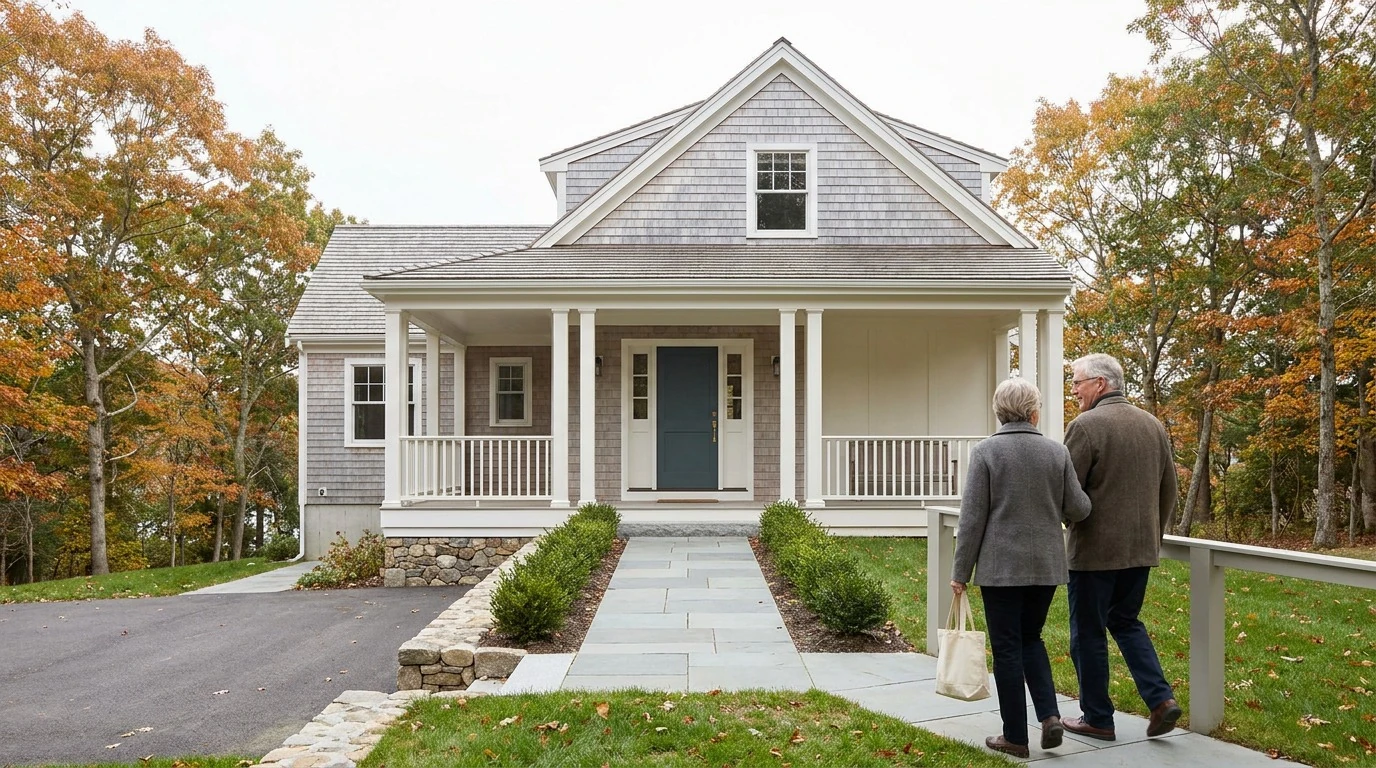
Cedar shingle remains the most requested siding on our North Shore projects because it ages with the New England landscape and holds resale value in towns where visual character matters. It is not the lowest-maintenance choice. Fiber cement is the material we recommend most often to homeowners who love the look of painted wood but do not want to repaint every seven years.
Roofing gets less design attention than siding, but it is the single system most vulnerable to Massachusetts weather. Architectural asphalt shingles rated for high-wind and impact zones cover roughly ninety percent of what we install because they balance cost, warranty, and appearance well. The two upgrade paths that matter are standing seam metal, which is our default recommendation for low-slope sections and modern architectural styles, and natural slate, which is only worth the cost premium on historically appropriate homes where the client is prepared to invest in a hundred-year roof.
Underneath any roofing material, the ice and water shield membrane is what actually prevents leaks. Massachusetts building code requires ice and water shield at eaves, and our specification exceeds code by extending the membrane six feet up-slope from the eave and across every valley, transition, and skylight. This is not a place to save money. The membrane costs a fraction of the roofing above it and prevents the leak repairs that ruin the interior finishes below.
Windows are the single largest source of energy loss in most Massachusetts homes and one of the most emotionally charged material decisions homeowners make. We steer clients toward triple-pane fiberglass or clad-wood units from manufacturers with a decade or more of proven performance in cold climates. The specification details that matter are the frame material, the spacer type, and the glazing package. A stainless steel or foam spacer, low-emissivity coatings on multiple surfaces, and argon or krypton gas fills add roughly ten to fifteen percent to window cost but reduce heating loss and eliminate the condensation that ruins interior trim over time.
Entry doors deserve the same scrutiny. A well-insulated fiberglass or solid wood door with a proper threshold sweep, quality weatherstripping, and a multi-point locking system will outperform a standard door for thirty years while contributing to the airtight envelope that makes the whole house more efficient.
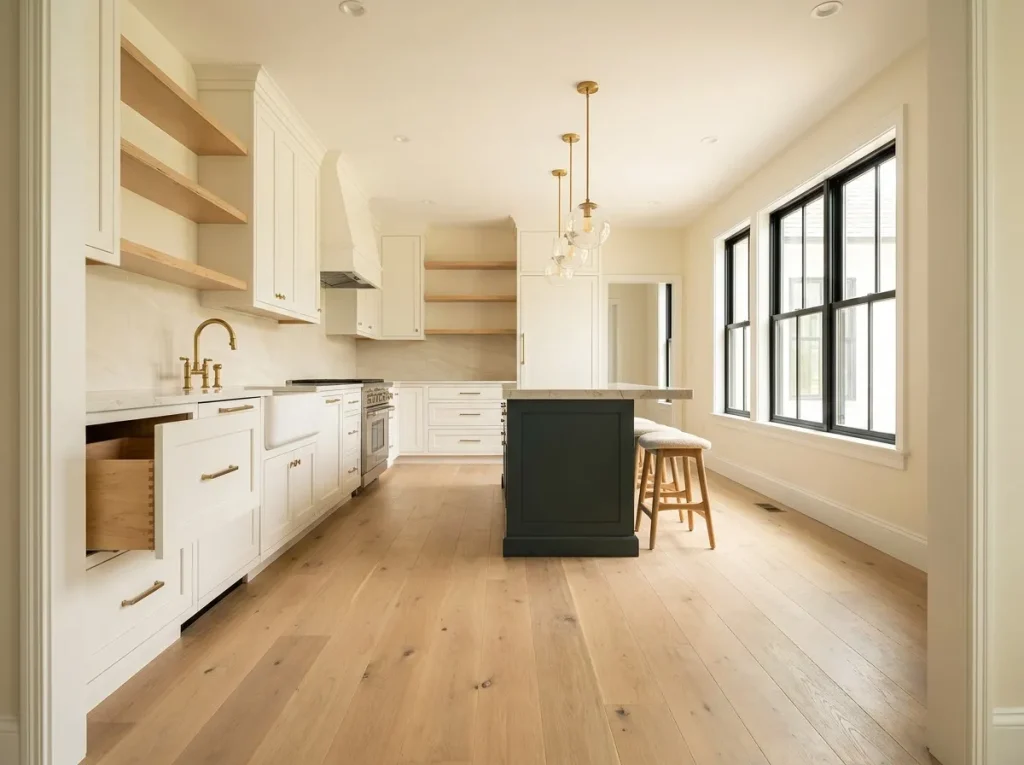
Interior finishes are what homeowners see and touch every day. This is where we spend the most time in material selection meetings, because these choices define daily life inside the home. Home building material selection for the interior breaks into flooring, cabinetry, countertops, tile, and paint and trim.
Wide-plank white oak, either engineered or solid, has become the default flooring across most of our custom builds. Solid hardwood is appropriate above grade in stable-humidity spaces. Engineered hardwood, with a real wood wear layer over a stable plywood core, is the correct call for basements, over radiant heat, and any space where seasonal humidity swings would move a solid board. Wide planks between six and eight inches read as more current than the narrow strips that dated builds from the 1990s and early 2000s.
For wet areas, large-format porcelain tile in twelve-by-twenty-four or twenty-four-by-forty-eight formats installed with narrow grout lines has replaced the small mosaic and small subway approach that dominated a decade ago. Porcelain reads more architectural, hides dirt better, and stays looking new for the life of the home.
Cabinetry is the interior element most homeowners regret cheaping out on. Custom or semi-custom cabinets built with plywood boxes, dovetail joinery, and full-extension soft-close hardware cost roughly thirty to fifty percent more than stock cabinets and last three times as long. The visual difference is subtle. The functional difference over twenty years is enormous.
Countertops are the surface homeowners touch every day, so material selection matters. The three categories that dominate current custom home construction are quartz, natural quartzite, and honed marble. Quartz is nonporous, forgiving, and available in patterns that convincingly mimic marble at a lower price and with no maintenance. Quartzite is a natural stone with excellent hardness and heat resistance, appropriate for homeowners who want the natural variation of stone without marble's staining risk. Marble remains beautiful but demands active sealing and stain-vigilant care, so we recommend it only for clients who understand the maintenance commitment.
Tile selection is where the design language of a home either holds together or falls apart. We coordinate every tile selection across kitchen, primary bath, secondary baths, and mudroom against the same underlying palette. This produces a home that feels coherent as you move through it rather than a set of rooms each shopping from a different catalog.
Paint and trim are the finish layer that ties everything together. High-quality trim paint, applied over primed and properly prepared substrate, holds color and sheen for fifteen years. Wall paint in the correct sheen, applied over the correct primer, holds up to normal family life without touch-ups for eight to ten years. Cutting corners on paint quality is one of the fastest ways to make a new custom home look worn in year three.
The single biggest predictor of a coherent, budget-controlled material package is when the decisions get made. Homeowners who lock materials during the design phase, before drawings are stamped and permits are pulled, end up with a home where every choice supports every other choice. Homeowners who defer these decisions to after framing typically face substitutions, contradictions between rooms, and the cost creep that comes from late-stage decisions.
Our design build construction workflow puts material selection meetings on the calendar during weeks four through eight of design development, running in parallel with structural and mechanical engineering. The architectural team, the interior designer, and the project lead all sit at the same table with the homeowner, and each material choice is evaluated against three questions: does it perform in the Massachusetts climate, does it fit the design language of the home, and does it hit the budget line we allocated to that scope. This coordinated approach is one of the reasons custom home design and build clients arrive at closing with fewer regrets than clients who worked through a traditional design-bid-build sequence.
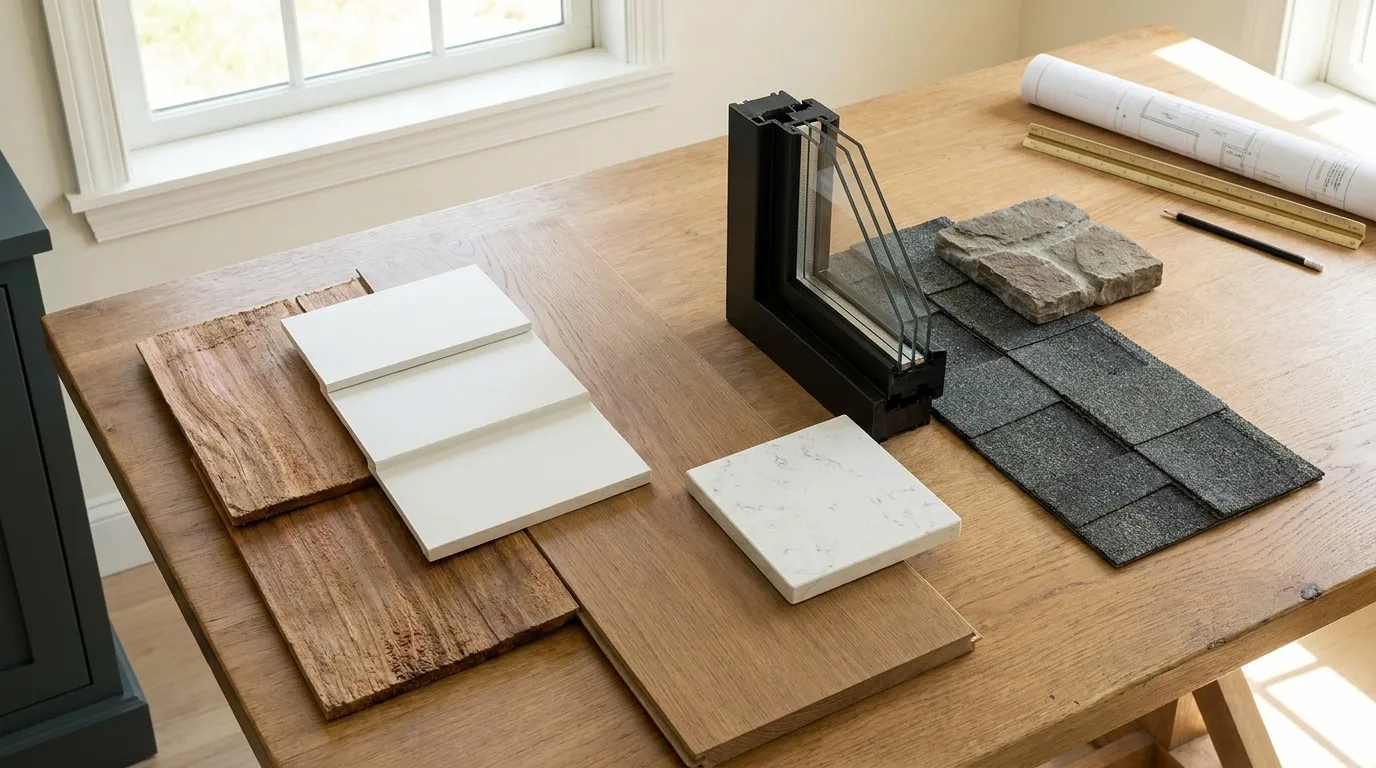
For homeowners who want to see how these selections tie into the broader project, our custom home construction team walks through material samples during the first design meeting so decisions are informed by the actual visual and tactile properties, not by web thumbnails. The design and build construction process gives us a structural advantage here: the same team recommending the material is the team installing it, so there is no misalignment between what was specified and what shows up on site.
A useful rule of thumb we share with clients is that the material budget on a Massachusetts custom home should distribute roughly as follows. This is a starting framework, not a fixed allocation, and it shifts based on style priorities.
The contingency line is the one homeowners consistently underestimate. Material lead times shift, discontinuations happen, and homeowners upgrade one or two categories once they see samples in person. A ten percent contingency built into the material budget prevents those moments from becoming stressful.
The most durable exterior custom home finishes for the Massachusetts climate are fiber cement siding, standing seam metal or architectural asphalt roofing with extended ice and water shield membrane, and triple-pane fiberglass or clad-wood windows. These materials handle freeze-thaw cycles, snow load, and coastal air without early failure. Cedar shingle is equally durable when properly detailed and maintained on a five to eight year restain cycle, and it is often the preferred choice for homes in traditional North Shore neighborhoods where visual character drives resale value.
The most effective balance is to invest in the finishes homeowners see and touch every day, such as flooring, cabinetry, and countertops, and select value-oriented options in lower-visibility categories like secondary bathroom tile or utility spaces. Wide-plank white oak flooring, plywood-box custom cabinetry, and quartz or quartzite countertops carry the highest daily impact per dollar spent. Paint quality and trim carpentry also punch above their cost, because they are the finish layer that determines whether the home reads as custom or builder-grade.
Material decisions for a custom home should be locked during design development, roughly weeks four through eight of design, before construction drawings are stamped and the building permit is pulled. Selecting materials early lets the design team coordinate every choice against structural details, mechanical clearances, and the overall aesthetic language of the home. Homeowners who defer material selection until after framing typically face substitutions from lead-time changes, price creep from late choices, and misalignment between what the drawings assumed and what actually gets installed.
Coastal North Shore towns like Beverly, Salem, and Marblehead demand materials engineered to resist salt air corrosion. Stainless steel or hot-dip galvanized fasteners, fiber cement or properly detailed cedar shingle siding, marine-grade hardware on exterior doors and windows, and copper or stainless flashing at every roof penetration all outperform standard specifications. Any low-grade steel fastener or aluminum flashing will show corrosion within five years within a mile of the coast, so the specification bumps for coastal properties are essential rather than optional.
We recommend building an eight to ten percent contingency into the material budget on any custom residential construction project in Massachusetts. Material lead times shift, products get discontinued between design and installation, and homeowners frequently upgrade one or two categories after seeing samples in person. A properly sized contingency turns those moments into manageable decisions rather than stressful budget surprises, and it is one of the simplest financial protections we build into every project.
Choosing custom home building materials well is the difference between a home that looks intentional for thirty years and one that begins to show its shortcuts by year five. The right decisions are the ones that account for Massachusetts weather, respect the design language of the home, and get made early enough that every choice supports every other choice. Genesis Construction and Development guides clients through this decision matrix during design, with samples, sight lines, and budget clarity. If you are planning a custom home build in Essex County, Middlesex County, or anywhere across the Greater Boston and North Shore market, contact our team to start the material selection conversation before design decisions get locked in.
© 2025 Genesis Construction and Development Inc. - All rights reserved | Web Design & SEO By: Authority Solutions®