Gut renovation usually makes sense when your home is structurally sound and renovation costs stay under about 30 percent of its value, while a full rebuild becomes the smarter choice once costs approach or exceed 50 percent of value or the structure has severe damage. In Middleton's premium market, both are major investments, so honest cost comparison is essential.
If you are staring at an outdated home in Middleton, MA, you are probably wrestling with a tough question: should you gut the house and renovate, or tear it down and rebuild from scratch? The answer is not always obvious, especially when gut renovations can run $50,000 to $250,000 while rebuilds cost $100 to $500 per square foot, and hidden problems like foundation damage or lead paint can blow your budget wide open.
In this guide, you will learn how to compare the true costs of each option, spot the warning signs that favor one approach over the other, and make a decision that protects your investment without overbuilding for your neighborhood. The right answer depends on your home's condition, your budget, and how long you plan to stay.
When you are facing a major home project in Middleton, MA, the first question is usually about money. The national average for new home construction in 2025 sits at approximately $195 per square foot including contractor overhead. For a typical 2,500 square foot home, that translates to roughly $487,500 in construction costs alone.
But Middleton's market adds its own complexity. With a median sale price of $778,000 and $381 to $384 per square foot, you are working in a premium market. The property tax rate of 1.29 percent versus the 1.02 percent national median means ongoing costs matter too. Demolition alone runs $4 to $17 per square foot, which means $10,000 to $42,500 for that same 2,500 square foot home. In Middleton, building permit fees cost $11 per thousand of construction cost with a $50 minimum for residential projects, while demolition permits run $100.
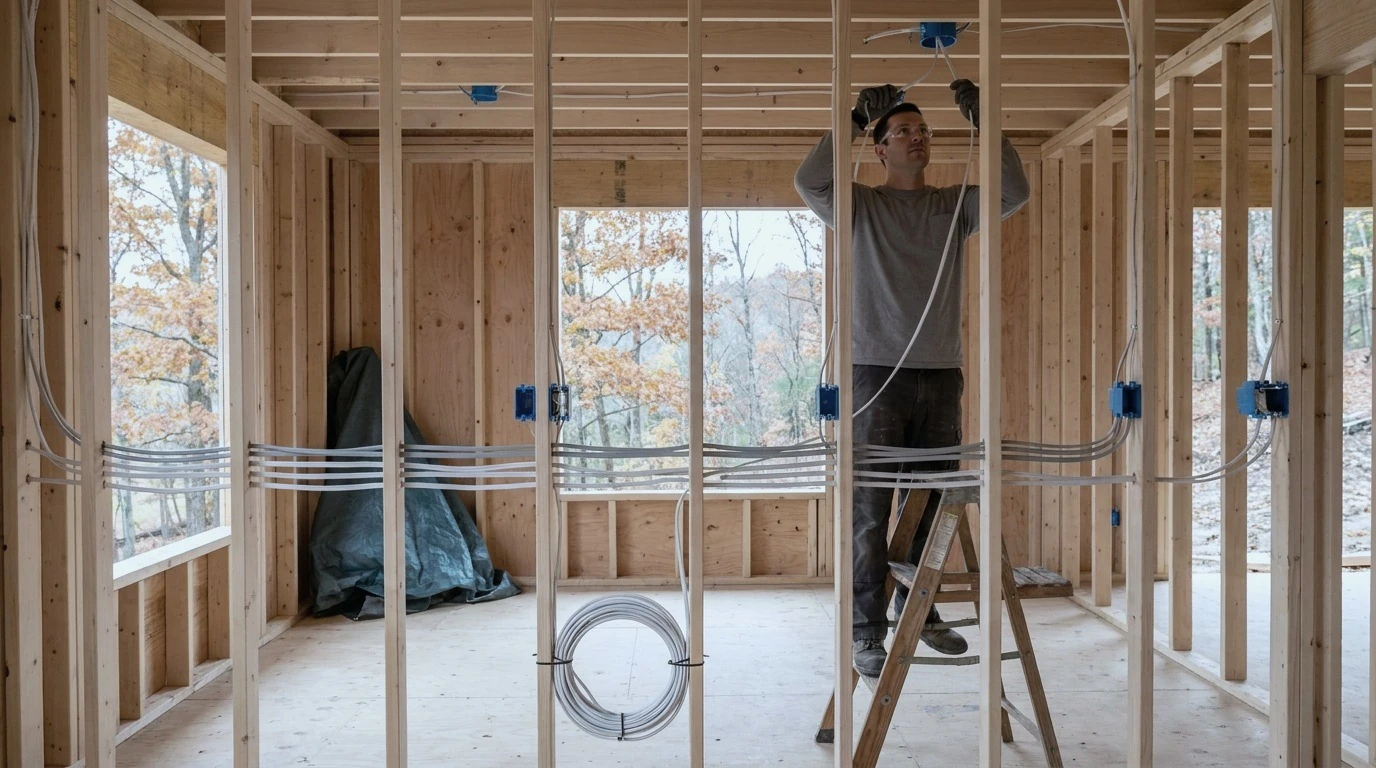
A gut renovation means stripping your home down to the studs and rebuilding from there. The scope is extensive, and costs add up quickly across multiple systems.
Demolition and removal form your starting point. Bathroom demolition alone runs $1,000 to $3,000, and that is just one room. If you are dealing with an older Middleton home, lead paint removal averages $3,499 but ranges from $1,478 to $5,520 at $6 to $17 per square foot. Your home's core systems represent significant investments:
| Gut Renovation Item | Typical Cost |
| Plumbing and electrical upgrades | $2,000 to $8,000 |
| HVAC replacement | $5,000 to $18,500 |
| Foundation repair (early) | $8,000 to $10,000 |
| Foundation repair (severe) | $25,000 or more |
| Flooring | $2 to $20 per square foot |
| Lead paint removal | $1,478 to $5,520 |
Once you open up walls, surprises emerge. Water damage remediation runs $1,361 to $6,270, while termite damage repair costs $1,000 to $10,000 for typical cases and up to $30,000 for severe infestations. You will also need somewhere to live during construction, and temporary housing typically costs 25 to 50 percent of your usual monthly housing costs for several months. Industry experts recommend adding 20 percent to your materials budget for contingencies. This buffer protects you when the unexpected happens, and it usually does.
For a comprehensive gut renovation of a 2,500 square foot Middleton home, expect to invest $150,000 to $300,000 or more. This includes all systems replacement, contingencies, and temporary housing costs. The timeline typically runs 8 to 10 months from start to finish.
Rebuilding means demolishing your existing structure and constructing a new home from the ground up. The process is longer and more complex, but it gives you a completely modern home.
The rebuild process unfolds in distinct phases: site preparation takes 2 to 5 days, demolition 1 to 7 days, debris removal and cleanup 3 to 10 days, foundation work 1 to 4 weeks depending on type, pre-construction phases 3 to 5 months, and construction 7 to 12 months. Altogether, you are looking at 12 to 18 months total from decision to move-in.
The Boston region commands premium construction costs. Local construction runs $200 to $250 per square foot given regional labor constraints and market conditions. For a 2,500 square foot home at $225 per square foot, construction alone costs $562,500. Add in demolition at $30,000 to $50,000, site preparation, permitting, architectural and engineering fees, and complete systems installation. A realistic total rebuild budget ranges from $600,000 to $750,000 or more. How the two paths compare:
| Option | Typical Cost (2,500 sq ft) | Timeline |
| Gut renovation | $150,000 to $300,000 or more | 8 to 10 months |
| Full rebuild | $600,000 to $750,000 or more | 12 to 18 months |
If renovation costs exceed 50 percent of your home's value, rebuilding often becomes the better financial decision. For a $778,000 Middleton home, that threshold sits at $389,000. This rule exists because at that point, you are paying nearly as much as a rebuild while keeping an older structure with potential future issues.
Choose renovation when your home is structurally sound but needs cosmetic upgrades, when unique architectural details or historical significance deserve preservation, when renovation costs stay within 30 percent of property value, or when you need a faster timeline of 6 to 12 months versus 12 to 18 or more months.
Consider a full rebuild when severe structural damage affects the foundation, walls, or support beams, when multiple significant issues would only receive temporary fixes through renovation, when the layout is inefficient and requires major structural changes, when extensive hazardous materials like asbestos or lead require expensive remediation, or when property value, energy efficiency, and customization are top priorities. In those cases, ground-up custom home construction delivers a fully modern home.
Not all renovation dollars return equal value. The 2025 Cost vs. Value Report shows exterior improvements deliver more value than interior remodels. The numbers tell an interesting story:
| Renovation Project | ROI | Cost and Return |
| Minor kitchen remodel | 112.9% | $28,458 returns $32,141 |
| Bathroom remodel | 74% | $25,251 returns $18,613 |
| Major kitchen remodel | 38% | $85,000 returns $32,300 |
The lesson is that targeted, strategic improvements often outperform massive overhauls from a pure financial perspective.
LEED-certified homes use 20 to 30 percent less energy than conventional homes, with some saving up to 60 percent. Whether you renovate or rebuild, investing in energy efficiency reduces ongoing costs and increases market appeal.
A 2,000 square foot ranch valued at $600,000 needs updating but has solid bones. Gut renovation costs $150,000 to $200,000, or 25 to 33 percent of value, with an 8 to 10 month timeline and an expected return of approximately $175,000 in added resale value. A rebuild would cost $450,000 to $600,000 or more with a 15 to 18 month timeline. Renovation is clearly the superior choice here.
A 2,500 square foot 1920s Colonial valued at $750,000 has multiple problems. Foundation repair runs $30,000 to $50,000, electrical replacement $25,000 to $35,000, plumbing $20,000 to $30,000, and water damage $15,000 to $30,000. Total renovation reaches $300,000 to $400,000, or 40 to 53 percent of value, exceeding the 50 percent rule. A rebuild at $500,000 to $625,000 becomes economically rational.
A 1740 Federal-period home valued at $850,000 carries historic designation. Exterior changes require Historical Commission approval, and demolition is likely prohibited. Renovation becomes the only viable path despite $250,000 to $350,000 costs and regulatory constraints.
Fannie Mae HomeStyle loans limit renovation costs to 75 percent of expected post-renovation value. FHA 203(k) loans require a minimum $5,000 borrowed with projects completed within 12 months. Home equity loans and HELOCs offer competitive rates but require sufficient equity. Cash-out refinancing requires 20 percent equity with closing costs of 2 to 5 percent of the new loan.
Construction loans are short-term instruments covering permits, materials, and labor. They convert to traditional mortgages upon completion. Higher interest rates during the construction phase mean extended timelines increase your costs.
Your choice of contractor affects both cost and outcome, and an experienced general contractor in Middleton brings the local knowledge to price both paths accurately. A design-build approach delivers 102 percent faster and shows 3.8 percent less cost growth compared to traditional design-bid-build. A unified design-build team reduces scheduling risks and communication gaps. You also get clearer total project cost pictures earlier in the process, which helps with budgeting and decision-making.
Homes over 200 years old require Historical Commission permits for significant changes. Work started without permits subjects you to fines and double permit fees. As of July 1, 2025, all projects must comply with the 10th Edition Massachusetts State Building Code, known as 780 CMR. This affects both renovations and rebuilds.
Before starting work, invest in proper testing. Professional radon testing costs $146 to $714, while DIY kits run $100 or more. Lead risk assessments range from $800 to $2,000. Brownfields properties may require contamination remediation, adding tens of thousands to project costs. Know what you are dealing with before committing to a plan.
The choice between gutting and rebuilding depends on your specific situation. Calculate your costs honestly, including contingencies and hidden expenses. Compare those numbers to your home's value using the 50 percent rule as a guide. Consider timeline needs, financing options, and your long-term goals for the property. A design-build partner can help you evaluate both paths with accurate cost projections and realistic timelines. For Middleton homeowners, the premium market means both options represent significant investments, and the right choice balances immediate costs, long-term value, and your vision for the home.
If your renovation costs exceed 50 percent of your home's value, rebuilding usually makes more financial sense. For a $778,000 Middleton home, that threshold is about $389,000, since at that point you are paying nearly rebuild prices for an older structure.
A comprehensive gut renovation of a 2,500 square foot home typically runs $150,000 to $300,000 or more, covering full systems replacement, contingencies, and temporary housing. Older homes with lead paint or foundation issues push toward the higher end.
A full rebuild generally ranges from $600,000 to $750,000 or more for a 2,500 square foot home, with local construction around $200 to $250 per square foot plus demolition, permitting, design fees, and complete systems installation.
A gut renovation typically takes 8 to 10 months, while a full rebuild runs 12 to 18 months from decision to move-in. The rebuild timeline includes demolition, several months of pre-construction, and 7 to 12 months of construction.
Common surprises include water damage remediation, termite damage, and foundation problems that escalate once walls open. Add 20 percent to your materials budget for contingencies, and factor in temporary housing during construction.
Targeted, exterior, and minor updates lead. Minor kitchen remodels return about 112.9 percent, bathroom remodels about 74 percent, while major kitchen overhauls return only around 38 percent, so strategic improvements outperform large-scale luxury renovations.
Renovate when your home is structurally sound, when renovation costs stay within about 30 percent of property value, when you need a faster 6 to 12 month timeline, or when unique architectural or historic details deserve preservation.
Rebuild when severe structural damage affects the foundation or framing, when multiple issues would only be temporarily patched, when the layout needs major structural change, or when extensive hazardous materials require costly remediation.
Homes over 200 years old require Historical Commission permits for significant changes, and demolition may be prohibited entirely. Starting work without proper permits subjects you to fines and double permit fees, so confirm requirements early.
Renovations can use Fannie Mae HomeStyle or FHA 203(k) loans, home equity loans, HELOCs, or cash-out refinancing. Rebuilds typically use short-term construction loans that convert to a traditional mortgage once the home is complete.
Deciding whether to gut or rebuild comes down to honest numbers and your home's true condition. For a structurally sound house that needs modernizing, a gut renovation is usually faster and more economical, especially when costs stay within 30 percent of value. Once renovation approaches the 50 percent threshold, or when severe structural damage and hazardous materials enter the picture, a full rebuild often delivers better long-term value, even at a higher price.
In Middleton's premium market, both paths are significant investments, and the wrong choice is expensive. Test before you commit, budget a real contingency, respect the historic and code requirements, and lean on a builder who will give you a straight structural assessment rather than a sales pitch. When you want an honest, numbers-first evaluation of both options, schedule a free consultation with a licensed local team.
Decide between gutting and rebuilding with confidence.
Get an honest assessment from Genesis Construction.
© 2025 Genesis Construction and Development Inc. - All rights reserved | Web Design & SEO By: Authority Solutions®