Interior finishes are the single most expensive part of building a custom home, at about 24 percent of construction costs, followed by major systems, framing, and exterior finishes. In Middleton, site-specific work like specialized septic systems and Massachusetts energy-code compliance can add tens of thousands of dollars more.
If you are planning to build a custom home in Middleton, MA, you are probably wondering where your budget will actually go. Interior finishes alone account for nearly a quarter of total construction costs, and when you add in Massachusetts' strict energy codes and potential site challenges like specialized septic requirements, the numbers can climb quickly.
Understanding which parts of the building process consume the most money, and why, helps you make smarter decisions, set a realistic budget, and avoid the costly surprises that derail up to 80 percent of construction projects. This guide breaks down each major cost category so you know exactly where your money goes and where thoughtful choices can protect your budget.
Interior finishes represent the largest single cost category in home construction, consuming 24.1 percent of total construction costs. This category encompasses everything from insulation and drywall to the final touches like lighting fixtures, cabinets, countertops, and flooring that transform a structure into a home. Because these choices are so visible and so variable, they are where careful custom home construction budgeting matters most.
Kitchen selections alone can dramatically impact your budget. Cabinets and countertops typically range from $5,000 to $25,000, with most homeowners spending around $10,000. Premium appliance packages can add another $8,000 to $15,000 compared to standard options. Flooring choices create equally significant cost variations. For a typical 2,000 square foot home, flooring costs can swing by $15,000 to $40,000 depending on whether you select luxury vinyl, hardwood, or premium tile throughout the home.
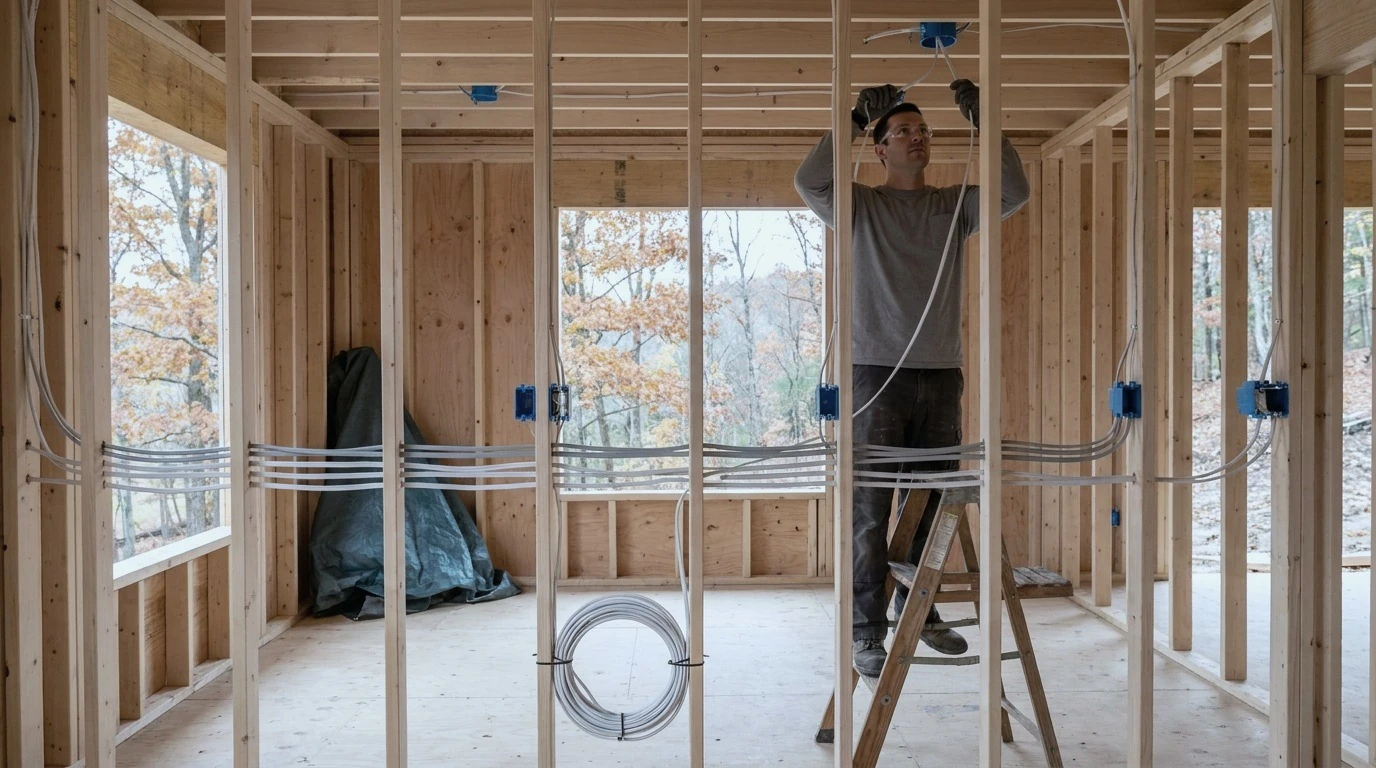
Major systems rough-ins constitute 19.2 percent of total costs, covering the plumbing, electrical, and HVAC installations that happen behind the walls. While these systems remain largely invisible once construction is complete, they represent critical investments in comfort, efficiency, and long-term value. Together with the categories that follow, they form the bulk of your construction budget:
| Cost Category | Share of Construction Cost |
| Interior finishes | 24.1% |
| Major systems (plumbing, electrical, HVAC) | 19.2% |
| Framing and structure | 16.6% |
| Exterior finishes | 13.4% |
| Foundation and excavation | 10.4% |
HVAC systems range from $5,000 to $25,000, with average installations falling between $8,500 and $15,000. Massachusetts homeowners increasingly opt for high-efficiency systems to manage heating costs during harsh winters. Ultra-high-efficiency systems with ratings above 21.0 SEER2 can cost $6,500 to $10,000 or more for equipment alone, plus $9,500 to $15,000 or more for installation. While the upfront investment is substantial, these systems deliver significant energy savings over their lifespan.
Plumbing costs scale directly with bathroom count, as the table below shows:
| Bathrooms | Plumbing Rough-In Cost |
| Single bathroom | $1,600 to $2,900 |
| Two bathrooms | $3,200 to $5,800 |
| Three bathrooms | $4,800 to $8,700 |
| Four bathrooms | $6,400 to $11,600 |
Material selection also affects costs. Copper pipes cost $4 to $12 per linear foot including labor, while PEX costs $1.50 to $4 per linear foot. Licensed plumbers command rates between $80 and $130 per hour on average.
Framing constitutes 16.6 percent of total costs, including framing lumber, roof trusses, sheathing, and metal or steel components. This structural skeleton determines your home's shape, strength, and long-term durability. Roof trusses average $16,500, ranging from $4,000 to $60,000 depending on complexity. Material costs range from $3.50 to $9.25 per linear foot, with labor installation between $25 and $75 per hour.
Design complexity substantially affects costs. Simple geometric shapes require fewer materials and less labor, while complex layouts with multi-pitch roofs or custom structural elements require additional labor and specialized craftsmanship.
Exterior finishes account for 13.4 percent of total costs, including siding, roofing, windows, and doors. These elements protect your investment from New England weather while defining your home's aesthetic character.
For a 3,000 square foot roof, the material you choose creates a wide cost range:
| Roofing Material | Cost (3,000 sq ft roof) |
| Asphalt shingles | $15,000 to $20,000 |
| Metal roofing | $17,000 to $30,000 |
| Slate or cedar shake | $27,000 to $50,000 or more |
Each material offers different lifespans, maintenance requirements, and aesthetic qualities, so the right choice balances upfront cost against how long you plan to stay.
Windows range from $100 to $200 per unit for basic quality to $300 to $600 or more for premium energy-efficient models. For a home requiring 15 to 20 windows, the difference between basic and premium can exceed $10,000. Massachusetts' updated energy codes require higher-performance windows than previous standards, increasing material costs but delivering better comfort and lower utility bills.
Foundation and excavation work accounts for 10.4 percent of total costs but shows the widest cost variability due to site-specific conditions. Middleton's geology and environmental regulations create unique considerations that can significantly impact budgets. Basement foundations are most common in Massachusetts, where footings must extend below the 42 to 48 inch frost line. Excavation costs in rocky areas can significantly increase budgets. Site preparation ranges from $10,000 to $50,000 or more depending on lot condition, which is why a knowledgeable general contractor in Middleton evaluates your lot before finalizing any budget.
Many Middleton areas are designated Nitrogen Sensitive Areas, necessitating specialized septic systems that add significant costs. Complete septic systems range from $3,615 to $12,408 depending on type and size, with typical 3 to 4 bedroom homes requiring $15,000 to $20,000 for complete installation. Building near wetlands or on sloping lots presents further difficulties and expenses that require careful evaluation during the planning phase.
Massachusetts has some of the most stringent building energy codes in the United States. While these regulations increase upfront costs, they deliver long-term benefits through reduced energy consumption and improved comfort. The specialized Massachusetts energy codes increase construction costs by roughly 1.8 to 3.8 percent, equating to approximately $10,000 to $23,000 for the median single-family home. The Commonwealth updates its building code every three years to maintain consistency with the most recent IECC version.
Current options include the Base Code, which is IECC 2021 with Massachusetts amendments, the opt-in Stretch Code, and the more stringent Specialized Code. Some towns have adopted even stricter optional codes that may require solar systems for new builds.
Labor represents 30 to 40 percent of residential construction costs. The construction industry faces significant workforce challenges that directly impact project costs and timelines. The construction industry needs 439,000 new workers to meet current demand, creating wage pressure in hot markets like Massachusetts. The aggregate annual impact of the skilled labor shortage in home building comprises $2.663 billion in higher carrying costs and $8.143 billion in lost single-family home building.
Electrical, plumbing, and HVAC contractors report multi-week delays just to start work, cascading into schedules and driving labor costs up. These scheduling challenges make it essential to work with an experienced design-build team that has established relationships with reliable trade contractors.
Materials comprise 45 to 50 percent of residential construction costs. Recent market conditions have created unprecedented price volatility that affects project budgets. Since February 2025, natural gas prices rose 30 percent, copper wire and cable increased 27.1 percent, and steel mill products increased 20.9 percent. Contractors report 9 percent overall material cost increases through mid-2025. Steel and aluminum tariffs added 25 percent overnight for imported product. These rapid price changes underscore the importance of working with builders who can lock in material pricing and manage supply chain relationships effectively.
Architectural fees typically range from 5 percent to 15 percent of total construction cost, with 8 to 15 percent most common for new custom homes. The investment in thoughtful design pays dividends throughout the construction process and the life of your home. For a $500,000 construction budget, fees would be $40,000 to $75,000, and for $1 million, $100,000 to $150,000. Custom floor plans, unique features, and sustainable design elements increase fees.
Homes with simple geometric shapes require fewer materials and less labor, while complex layouts with gabled roofs, curved walls, or custom structural elements require additional labor and specialized craftsmanship. A skilled design-build team can help balance architectural vision with budget realities.
The American Institute of Architects recommends owner contingencies of 5 to 10 percent of overall construction cost. For a $428,000 construction budget, this represents $21,000 to $43,000 in reserves. This contingency is not pessimism, it is prudent planning. Up to 80 percent of construction projects experience cost overruns, with change orders accounting for 7 to 15 percent of total project costs, and up to 30 percent of change orders are tied to inadequate planning or incomplete designs.
Contractors using historical data in pre-bid planning report 20 percent fewer cost-related change orders. Projects with standardized change order processes reduce administrative delays by over 50 percent.
Design-build delivers both design and construction under one contract, creating stronger collaboration between designers and builders. This integrated approach offers significant advantages for managing costs and timelines. A design-build approach typically results in more stable costs, faster timelines as design and construction phases overlap, and a single point of contact throughout the project. Design-build projects typically use fixed-price contracts established after the design phase, providing cost certainty and fewer mid-project adjustments.
The design-build team can collaboratively optimize material choices and construction methods to balance aesthetics and cost during the design phase, before costs become fixed. This early collaboration prevents costly redesigns and ensures your vision aligns with your budget from the start.
Interior finishes are the largest category at about 24.1 percent of total construction cost. Kitchen cabinets and countertops run $5,000 to $25,000, and flooring choices alone can swing a 2,000 square foot home's cost by $15,000 to $40,000.
HVAC systems typically run $5,000 to $25,000, with most installations between $8,500 and $15,000. Ultra-high-efficiency systems above 21.0 SEER2 cost more upfront, from $6,500 for equipment plus installation, but deliver long-term energy savings.
Plumbing scales with bathroom count, from roughly $1,600 to $2,900 for a single bathroom up to $6,400 to $11,600 for four bathrooms. Copper piping costs more than PEX, and licensed plumbers charge $80 to $130 per hour.
Framing is about 16.6 percent of total construction cost, covering lumber, roof trusses, sheathing, and structural components. Roof trusses alone average $16,500, ranging from $4,000 to $60,000 as design complexity increases.
Many Middleton lots sit in Nitrogen Sensitive Areas requiring specialized systems. A complete septic installation for a typical 3 to 4 bedroom home runs $15,000 to $20,000, more than standard systems, so factor it in during site evaluation.
The specialized energy code adds roughly 1.8 to 3.8 percent to construction cost, about $10,000 to $23,000 for a median single-family home. The tradeoff is lower utility bills and better comfort through New England winters.
Keep 5 to 10 percent of your construction cost in reserve. On a $428,000 budget, that is $21,000 to $43,000. With up to 80 percent of projects experiencing overruns, this cushion prevents running out of funds mid-build.
Labor is 30 to 40 percent of cost and faces a shortage of hundreds of thousands of workers, while materials are 45 to 50 percent and have seen sharp recent increases in gas, copper, and steel, plus tariff-driven jumps on imports.
Architectural fees typically run 5 to 15 percent of construction cost, with 8 to 15 percent most common for custom homes. On a $500,000 build, that is $40,000 to $75,000, and complex designs push fees toward the higher end.
Design-build puts design and construction under one contract, enabling fixed-price budgeting, overlapping phases, and early collaboration. The team optimizes materials and methods before costs are locked in, reducing change orders and mid-project surprises.
The most expensive part of building a custom home is consistent across projects: interior finishes lead, followed by major systems, framing, and exterior work. But in Middleton, the numbers that most often catch homeowners off guard are the site-specific ones, from Nitrogen Sensitive Area septic systems to rocky excavation, along with Massachusetts' demanding energy code. Knowing these cost drivers upfront is what separates a realistic budget from an optimistic one.
The good news is that none of these costs have to become surprises. With early planning, honest site evaluation, and a builder who can lock pricing and optimize choices before they are fixed, you keep control of the budget from day one. When you want a clear picture of what your Middleton home will really cost, schedule a consultation and start with numbers you can trust.
Know where your custom home budget goes.
Plan your Middleton build with Genesis Construction.
© 2025 Genesis Construction and Development Inc. - All rights reserved | Web Design & SEO By: Authority Solutions®