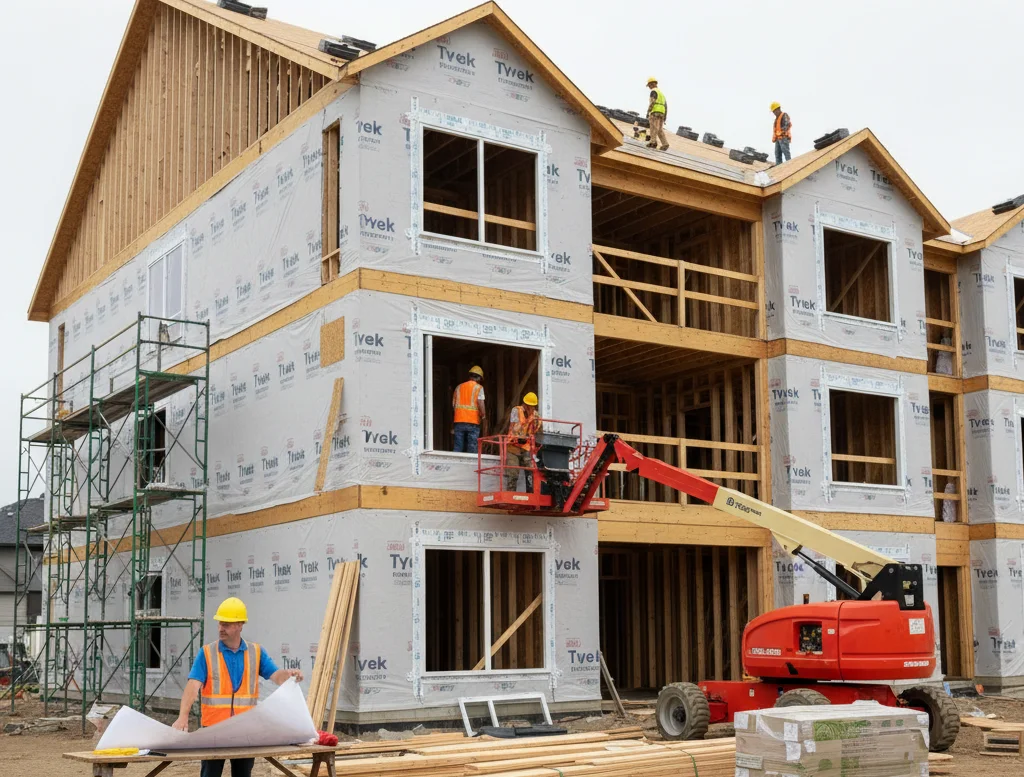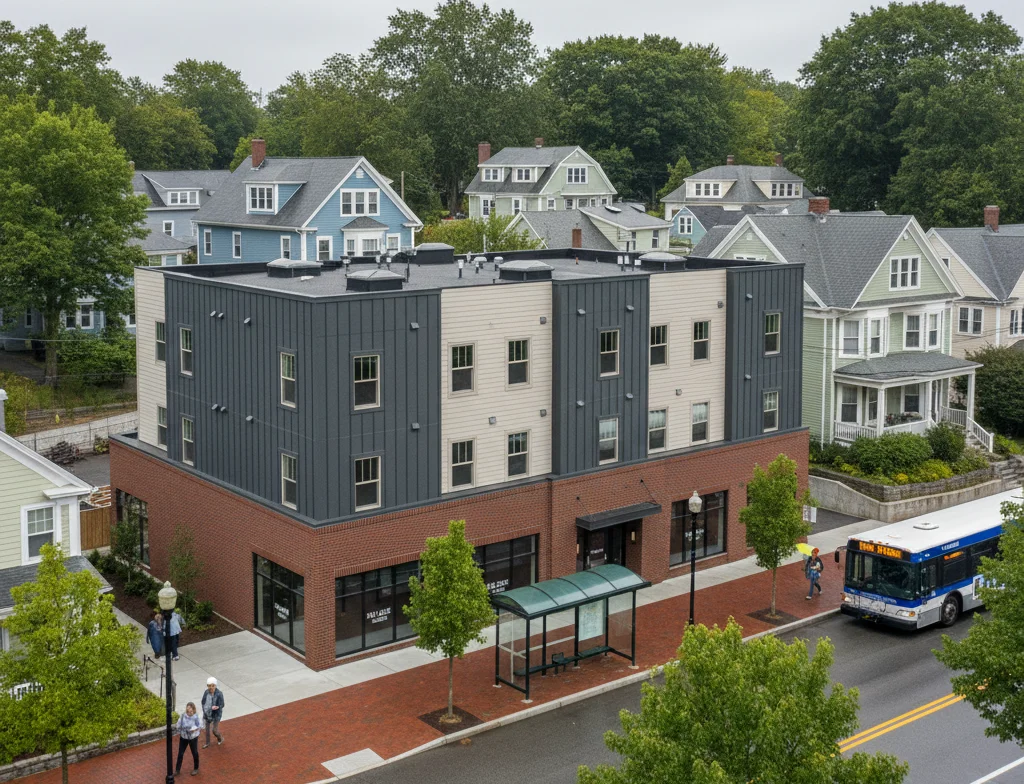
MBTA Communities zoning requires 177 transit-served Massachusetts towns to allow multifamily housing by right in at least one district near transit stations, fundamentally reshaping suburban land use patterns and development opportunities for a multifamily builder.
MBTA Communities zoning is changing suburban development — and multifamily housing construction — by requiring many transit-served towns to allow multifamily housing by right in at least one reasonably dense district. This shifts land use away from single-family-only neighborhoods, concentrates new homes near transit, and encourages mixed-use areas with taller buildings and less parking. Towns must manage added pressure on roads, water, sewer, and schools while using design rules to fit growth into local character.
Although the phrase "MBTA Communities zoning" can sound technical, the legal framework behind it rests on a clear, simple idea: cities and towns served by MBTA transit must create at least one zoning district where multi-family housing is allowed by right. This rule comes from Section 3A of Chapter 40A, which applies to 177 MBTA-served municipalities, excluding Boston, and focuses on zoning rules rather than forcing construction.
The law defines multi-family districts that must be reasonably sized, allow family-suitable units, and prohibit age restrictions. The Executive Office of Housing and Livable Communities, working with transportation and economic agencies, sets guidelines and exercises a state advisory role. If a community's zoning does not comply, it risks losing access to key state funding programs and may face enforcement.
Over the past few years, a clear sequence of deadlines and legal decisions has reshaped how MBTA Communities zoning works in practice. Initial timelines began with August 2022 guidelines, January 2023 action plans, and staggered compliance dates running through the end of 2025. As of the Supreme Judicial Court's January ruling, 116 communities had complied, demonstrating broad momentum toward meeting the law's zoning requirements.
Milton's brief compliance, followed by a voter referendum and state lawsuit, highlighted how the public involvement process can both advance and disrupt zoning progress. The Supreme Judicial Court's January 2025 ruling affirmed the law's constitutionality, strengthened the Attorney General's enforcement power, and clarified that noncompliance penalties cannot be limited to loss of state grants.
| Timeline Milestone | Requirement | Significance |
| August 2022 | EOHLC releases compliance guidelines | Establishes criteria for multi-family districts |
| January 2023 | Action plans due for many communities | Communities commit to compliance timelines |
| December 2024-2025 | Final compliance deadlines for most towns | Zoning must be adopted or funding at risk |
| January 2025 | Supreme Judicial Court ruling | Affirms law constitutionality and enforcement power |
Courtroom outcomes and regulatory deadlines now set the stage for what residents actually see on the ground: a steady reshaping of suburban land use and density patterns in MBTA Communities. Single-family zoning near stations is giving way to mixed-use and multifamily districts, often placed along existing commercial corridors or established apartment areas. This approach seeks to protect community character in quieter streets, while still allowing more homes where infrastructure already exists.
New rules require minimum densities, such as 10–25 units per acre, and permit taller buildings, reduced parking, and mixed-use forms. Duplexes, townhomes, and small multifamily buildings are allowed as of right, shifting development form as market dynamics respond. Even an experienced custom home builder may find new opportunities in these transit-oriented districts. These changes concentrate growth, increasing pressure on water, sewer, roads, and local services.
Key density and form changes:
In many MBTA Communities, new multifamily zoning is beginning to translate into real additions to the housing pipeline, modest in scale so far but meaningful in direction. With 133 communities approving districts and more than 4,000 units in progress, these changes are beginning to address regional shortages across Greater Boston and nearby Gateway Cities. For firms focused on custom residential construction, the new zoning opens paths to diversify into transit-adjacent multi-family work.
Regional needs remain steep, with projections indicating that substantial additional homes will be required over the next decade. New districts concentrate homes near transit, shaping anticipated market shifts as land becomes more efficiently used. Modest affordability requirements, typically 10 percent, slightly temper housing pressure, while market-rate production can ease demand on older, less expensive rentals.
Local officials now face the practical work of shaping transit-oriented overlay districts that meet state rules while fitting local goals. A design-build construction company with local relationships can help navigate these overlay requirements and move from zoning approval to construction faster. They must balance increased density with thoughtful design standards, using tools such as height limits, step-backs, and open-space requirements to manage change on the ground. At the same time, communities need to coordinate zoning with infrastructure planning, ensuring that transportation, water and sewer systems, schools, and public services can support new housing over time.
Although the MBTA Communities law sets the baseline requirements, the real work of designing a transit-oriented overlay district is done through careful local mapping and zoning decisions. Planners define district geographies within a half-mile of stations, adjust boundaries to avoid wetlands and constrained parcels, and test different residential unit mixes to satisfy Section 3A's focus on family-suitable homes.
Key district design decisions:
Thoughtful mapping of a transit-oriented overlay district is only the first step; the next challenge is deciding how much new housing to allow, and what it should look like, on the ground. MBTA Communities zoning pushes higher residential densities, yet towns still retain tools to manage form and scale.
Overlay districts concentrate growth near stations, while form-based rules, such as height limits, step-backs, and façade modulation, guide targeted building massing so larger buildings meet the street more gently. Lot coverage rules and unit size constraints can steer development toward smaller, more numerous homes, like duplexes and triple-deckers, instead of a few massive blocks.
When zoning changes open the door to new housing around transit, the next question is whether streets, pipes, and public services can keep up. Under the MBTA Communities framework, local capital planning and zoning need to move together, not in parallel. Communities must align new districts with realistic financing for infrastructure upgrades, using grants, local bonds, and ARPA funds in a coordinated way.
Infrastructure coordination strategies:
Even as most MBTA communities move toward compliance, the new multifamily zoning rules have triggered sharp debates over local control, legal exposure, and who ultimately benefits from the changes. In several towns, residents question whether the public engagement process is sufficient, raising concerns about traffic, school capacity, water systems, and the preservation of neighborhood character.
Legal risk is also a flashpoint. Non-compliant towns face enforcement under Section 3A, which requires as-of-right multifamily districts near transit. While over 100 communities have acted, some concentrate zoning in commercial areas, limiting change in single-family neighborhoods. Equity debates center on who gains access to new homes, with supporters citing options for young families, seniors, and lower-income renters.
| Debate Area | Common Concerns | Implementation Response |
| Local Control | Loss of municipal zoning autonomy, state mandate | Communities retain design standards, phasing options |
| Infrastructure Capacity | Water, sewer, roads, schools may be strained | Coordinated capital planning, state infrastructure grants |
| Legal Exposure | Enforcement actions, funding loss, litigation | Attorney General enforcement power, compliance deadlines |
| Equity & Access | Who benefits from new housing opportunities | Affordability requirements, diverse unit types near transit |
The MBTA Communities Act is expected to improve resale value and marketability for many properties by encouraging housing development near transit-accessible areas. Homes near MBTA stations, especially those close to public amenities, often attract buyers seeking convenience and long-term growth. While future taxes may rise, properties that help comply with the law are generally viewed as lower-risk and more attractive investments amid the region’s ongoing housing shortage.
New buildings shaped by local zoning updates may feature higher density, shared entrances, and modest height increases to support housing units beyond traditional single-family homes. In areas influenced by the MBTA zoning law, design changes often aim to support walkable neighborhoods, balancing neighborhood character with the need for more homes.
Homeowners can engage by attending meetings, submitting written feedback, and urging officials to submit an action plan that reflects community input. Reviewing compliance with the MBTA Communities zoning law helps residents determine whether their municipality meets the required zoning capacity thresholds. This involvement is significant in non-compliant communities facing state deadlines.
Yes. As housing production increases and new units are added near public transit, local retail and services often follow. Areas surrounding rail or commuter rail stations may gradually shift toward mixed-use development, while grant programs can help fund infrastructure that supports small businesses and improves streetscapes.
By focusing growth near transit—such as a rapid transit community or commuter rail corridor—planning efforts reduce car dependence and emissions—requirements like allowing 15 units per acre within 0.5 miles of a station support compact growth. In places like the Town of Milton, zoning changes may increase opportunities for diverse housing units, including single-family dwellings, affordable housing, subsidized housing, and dedicated affordable units, strengthening resilience while meeting state goals.
MBTA Communities zoning is reshaping how suburbs plan for growth, pushing towns to accept more housing near transit, and linking local decisions to statewide goals. As legal deadlines tighten and court rulings clarify the stakes, communities that plan carefully, use clear implementation tools, and confront equity issues directly will be better positioned. This framework will not solve the housing crisis alone, but it is already steering suburban development toward greater density, access, and long-term stability. Genesis Construction and Development specializes in builder-led design-build projects that navigate complex zoning requirements, including MBTA Communities compliance, helping property owners and municipalities realize multifamily and mixed-use developments that meet regulatory standards, respect neighborhood character, and deliver quality construction outcomes.
© 2025 Genesis Construction and Development - All rights reserved | Web Design & SEO By: Authority Solutions®